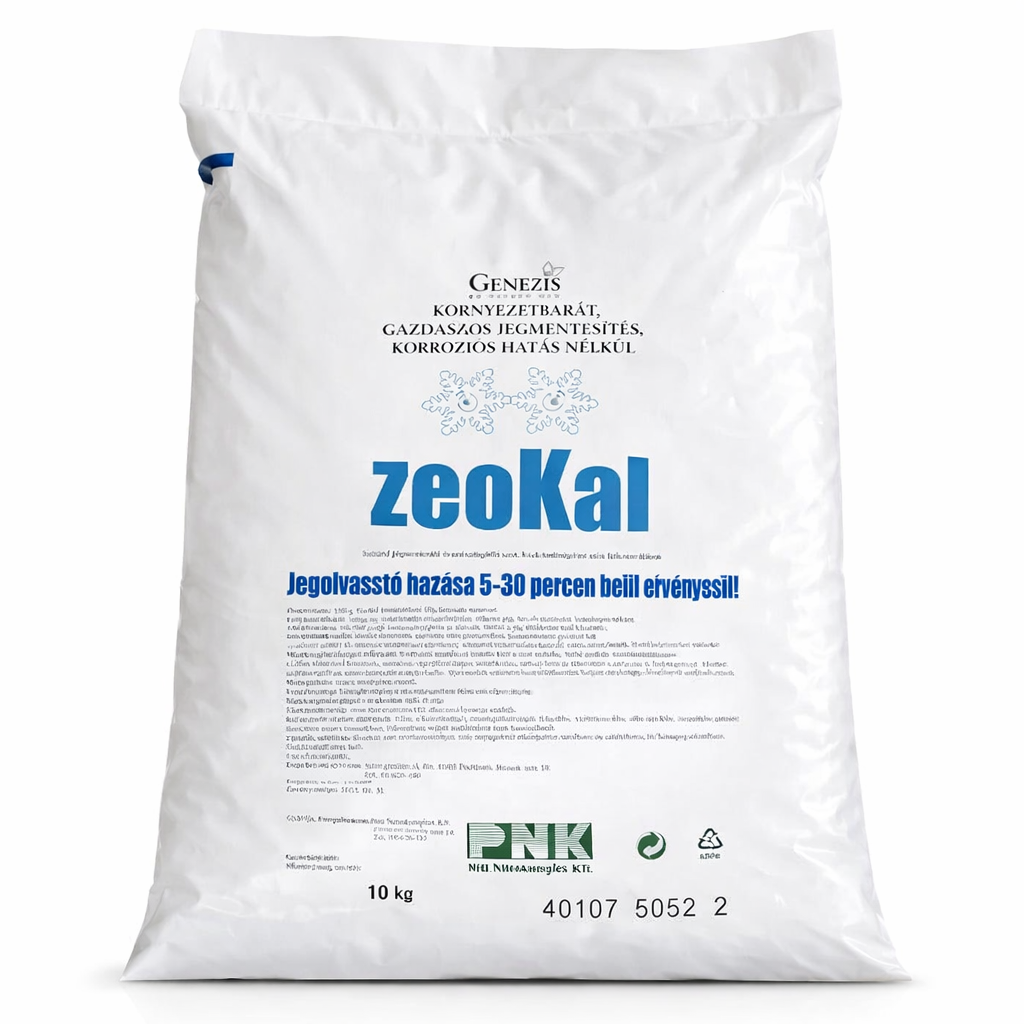
ZeoKal de-icer 10 kg
Solid anti-slip agent (zeolite containing calcium nitrate)
Environmentally friendly, economical anti-corrosive treatment without corrosion effect!
For anti-slip, anti-freezing; thin ice or snow melting of ice and snow on roads, pavements, stairs, parking lots.
Advantages of the application:
- Anti-corrosive and environmentally friendly
- Chloride-free - It also significantly extends the life of the built environment, reinforced concrete (concrete) structures, transport equipment (metal), monuments, bridges.
- Nature-friendly - its components are rapidly degradable and the zeolite mineral loosens the soil
- Good adhesion and fast melting effect
- Easy to spread
Mechanism of action:
Easier to apply than liquid ice melting agents, thanks to special equipmentIn the case of liquid ice melt, it can be applied by hand (leather, plastic or rubber gloves). On the other hand, it is less sensitive to the quantity of liquid than liquid products.The melting effect is slower because some of the calcium nitrate from the porous zeolite is released more slowly onto the ice surface. However, the calcium nitrate adhering to the surface of the zeolite granules acts immediately after dispersion and the granules are absorbed into the holes created by the melting of the ice and are then released into the ice.and reduces the possibility of slipping and the drifting effect of vehicle traffic.and is therefore preferable to purely mechanical de-icers.
Of course, it can also be applied with sand of similar particle size, mixed with gravel, but it has a melting effect.Its melting effect will be slower and less pronounced, but it will increase their (the mechanical anti-slip agents') effectiveness.
The leaching calcium nitrate solution behaves in a similar way to Kalcinol 30, i.e. it perforates the ice and makes itand spreads out underneath to melt the thin layer of ice adhering to the road surface. This allows the ice to be broken up and removed without melting the main mass. Removing the entire mass of ice would require a very large amount of solvent.
Areas of use
- Can be used in normal winter conditions between 0 and -15 C.
- Primarily for the anti-slip application on surfaces covered with snow and ice.
- Can also be used during snowfall. Retains its effectiveness longer if fresh snow is spread on the ground before application.(with a front sweeper or snow blower attachment on a sprayer).
- It can also be usedas a preventive measure, but on busy roads it is better to use Kalcinol, as the liquid adhering to the surface will not be washed off by vehicles.
Advantages over other melting agents:
- It has the advantage of solid de-icers over liquid de-icers (slower melting in the case ofIt has advantages over solid ice melters in that it has the advantage of having a slower melting rate (it has time to absorb the heat of the melting from the environment and the road surface cools less).
- Does not contain chloride.
- It does not corrode roadside structures or vehicles.
- Its nitrogen content does not accumulate along roadsides like chloride salt, but provides a useful nutrient for plants. The zeolite remains in situ, but is broken down and improves soil structure.
- Its active ingredient content nourishes the vegetation along the roadsides.
Application doses:
For de-icing, 5-20 dkg/m2 Zeokal is sufficient depending on the uniformity of spreading depending on the terrain conditions.
It is advisable to measure and optimise the dosage by spraying trials (minimising the quantity).while still achieving adequate melting or skid release).
During snowfall and for preventive purposes, the same quantities as described above can be used.
Golden rules for ice and slip discharge:
- No magic formula! There is no chemical that can melt any amount of snow or ice quickly and cheaply! The road surface becomes significantly overheated compared to the lower layers, contracting, creating stress and cracking!
- It follows from the foregoing that the best de-icing technology (for both economic and environmental reasons) is the following: Remove what can be removed mechanically (sweeping, snow-sweeping, snow-mowing), then apply the de-icing material
- Prepare in time, based on forecasts, with an elaborate technology and product for appropriate de-icing. It is best to start with prevention. Prevention of icing fog, dry road surface, near freezing pointA material-saving solution is to dilute the Kalcinol 30 to be sprayed with water (half or one third water).
- Multiple applications of small doses (4-10 ml/m2) are more effective. If possible, remove partially melted, loosened ice and snow as quickly as possible.
- Depending on the conditions (weather, terrain, etc.), a different material, dosage and technology is always most effective for icy and snowy roads. Ask NZRt and PNK Ltd's sales and marketing departments for advice.
- Measure the sprayer or spraying machine for optimisation (saving material - achieving the right effect). Check the amount of material applied per 10-100 square metres and adjust the recommended rate. Note that increasing the forward speed will reduce the amount of material applied per unit area, while slower forward speeds will increase the amount of material applied per square metre.
| Weight: | 10 kg |
|---|---|
| Aviability: | 1-4 nap |
| Basic sales unit: | db |
Login
Login